
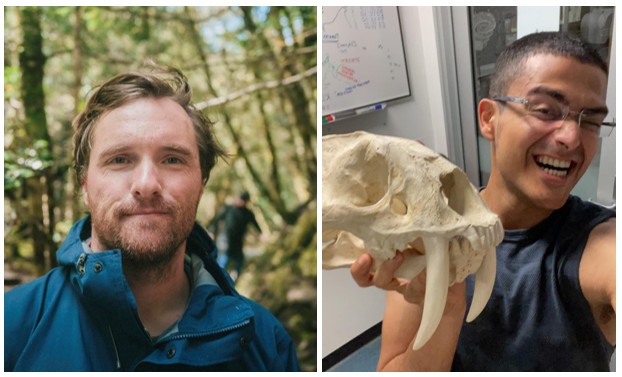
“Spit it Out! How fossils from bird vomit are helping understand Australia’s ecosystems, past and present"
Dr Vikram Vakil – The University of Queensland
Abstract:
Australia’s mammal extinctions have accounted for the loss of over 30 species since European colonization - amounting to over 50% of global mammal extinctions. A combination of climatic and human-driven or anthropogenic factors is responsible for their losses. A better understanding of the responses of our native mammals to on-going environmental changes is possible by examining their past responses to such changes that could potentially aid in their effective conservation. This talk explores how the geologically recent fossil record, especially late Quaternary provides an opportunity to assess the past responses of mammals at risk today and how this knowledge can be used to inform future trajectories of our endangered, at-risk species.
Bio:
Dr Vikram Vakil. I’m a palaeontologist with an Honours, Masters by research and PhD degrees in Geology and Palaeontology. My area of research includes but is not limited to geochemistry of Australian dinosaur bones, morphometrics of postcranial remains of extinct marine reptiles like plesiosaurs and ichthyosaurs and taphonomy and palaeoecological studies on the fossils of small-bodied mammals from northeastern Australian caves. I also have specific interest in astrophysics and quantum mechanics, especially in the quantum nature of event horizons of supermassive black holes.
“The evolution of semelparity in response to intense sexual competition and sexual conflict”
Dr Keahgan J Yaxley – The University of Queensland
Abstract:
Semelparity – reproducing once in a lifetime – represents an extreme solution to the trade-off between reproduction and future survival. While semelparity is a widespread life-history strategy among plants, it is uncommon in animals and exceedingly rare in terrestrial vertebrates. A notable exception is Antechinus. Males of all fifteen species invest lethally in reproduction to meet the energetic demands of their highly competitive ruts. To understand the evolutionary drivers of such an extreme reproductive strategy, I developed a novel two-sex integral projection model (IPM). Under this model, increased investment in reproduction leads to increased fecundity, but at a cost to future survival. We can use this model to test whether sexual competition alone can drive males to invest lethally in reproduction.
Bio:
I am a postdoctoral fellow at the University of Queensland working on a project co-supervised with Prof Diana Fisher. My background is in macroevolution and macroecology, phylogenetic inference and comparative methods and incorporating evolutionary history into conservation planning. I completed my PhD at the University of Cambridge in 2023 before working as a researcher at the Australian National University and as a quantitative ecologist in local government. In my current role I will be using comparative methods and quantitative modelling to investigate the evolutionary drivers of semelparity in animals.
About Seminar Series
The School of the Environment Seminar Series (a.k.a. SENVinars) — held in-person on campus and online via Zoom — invites national and international experts to present their current research outcomes and priorities for disciplinary areas aligned with our School.
Our presenters include current research academics, visiting researchers, collaborators from industry and government.
SENVinars promote the exchange of ideas, new collaborations and strengthen current partnerships. They are attended by our large and diverse community of academics, professional services staff, higher degree by research scholars, postgraduate research and Honours research students.
Questions? Please email - senv.gsa@uq.edu.au